
Table of Contents
ToggleConcrete Block Calculator (CMU Wall, Fill, and Cost Estimator)
Last updated: March, 2026
This professional concrete block calculator determines the total number of CMUs, mortar bags, and grout volume required for masonry walls. By inputting wall length and height, subtracting openings, and applying a 5–10% waste factor, estimators can generate accurate material lists for residential and commercial projects.
Concrete Block Calculator
Modern, fast, and accurate — plan your block walls with confidence.
Wall Dimensions
Block & Joint
Openings (Doors/Windows)
Options
Results
How a Concrete Block Calculator Works
A Block Calculator operates on a straightforward mathematical logic to transform your wall dimensions into a tangible shopping list.
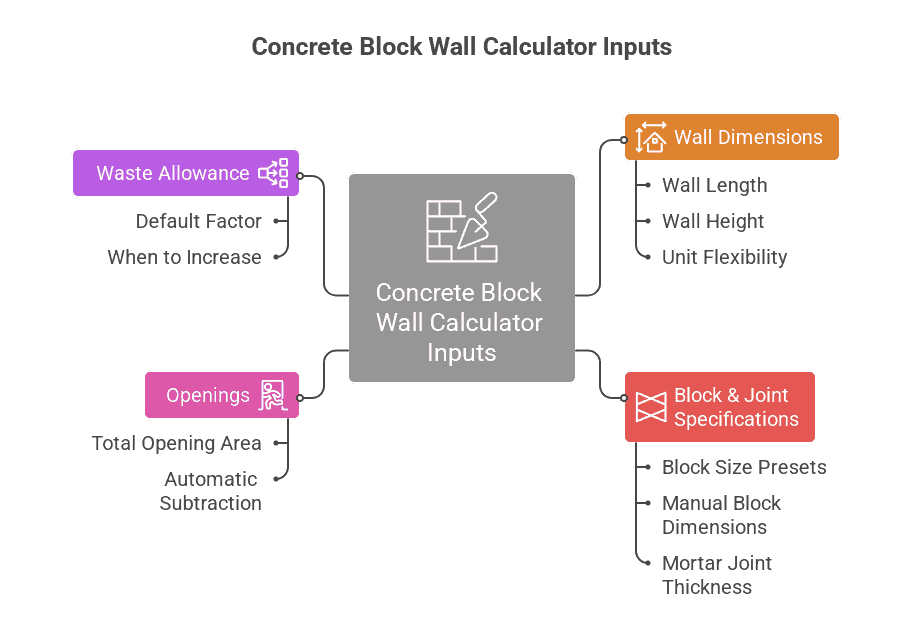
Essential Inputs
To get started, you will typically need to provide:
- Wall Length and Height: The total span and vertical reach of the structure.
- Block Size: The dimensions of the specific units you plan to use.
Real-World Outputs
Once the data is processed, the tool provides:
- Total Number of Blocks: The exact count of units required to cover the surface area.
- Mortar Estimate: Calculation of the bonding material needed between joints.
- Cost Approximation: A rough budget based on current material prices.
Concrete Block Dimensions Explained
Understanding Concrete Block Dimensions is the foundation of any accurate estimate.
- Standard Sizes: The most common Concrete Masonry Unit (CMU) in North America is the 8 × 8 × 16 inch block.
- Regional Variations: Depending on your location, “standard” sizes may vary slightly to accommodate different building codes or architectural styles.
- Why Dimensions Matter: Even a half-inch difference in block size can result in a significant shortage or surplus when scaled across a large Square Foot area.
How to Calculate Concrete Volume
Understanding how to Figure Yards of Concrete is vital for footings and pillars.
The Cubic Yard Formula
Concrete is measured in Cubic Yards. For a basic slab or footing, use this formula:

Concrete Cylinder Calculations
For vertical pillars or round columns, you need to calculate a Concrete Cylinder volume. This ensures your structural supports are poured with the correct amount of material to handle the load.
Step-by-Step Usage Guide
Follow these steps to get an accurate estimate:
- Measure: Use a tape measure to find the exact length and height of your planned wall.
- Select Block: Choose your block size (e.g., 8 × 8 × 16).
- Input Data: Enter these figures into the Concrete Block Calculator.
- Review: Check the output for total blocks and mortar requirements.
Example Scenario: If you are building a wall 10 feet long and 4 feet high using standard 8 × 8 × 16 blocks, the tool will quickly calculate that you need approximately 45 blocks (accounting for the standard 3/8 inch mortar joint).
Benefits of Using a Concrete Block Calculator
- Saves Time: Instant results replace manual, error-prone math.
- Reduces Waste: Order exactly what you need, making your project more eco-friendly and cost-effective.
- Budgeting Accuracy: Know your costs upfront before you head to the hardware store.
Common Mistakes to Avoid
- Incorrect Measurements: Even being off by a few inches can ruin your estimate.
- Wrong Block Size: Ensure the size in the calculator matches the physical blocks you are buying.
- Ignoring Mortar Allowance: Always account for the space between blocks; failing to do so will result in ordering too many blocks
Related Calculators
Frequently Asked Questions (FAQs)
For a standard 8 × 8 × 16 block, you generally need 1.125 blocks per Square Foot of wall area.
"CMU" (Concrete Masonry Unit) is the modern industrial term. "Cinder block" refers to older units made with coal cinders; today, most people use the terms interchangeably for concrete blocks.
Multiply length x width x thickness (all in feet) and divide the total by 27.
It depends on bag size; typically, it takes forty-five 80 lb bags or sixty 60 lb bags to reach 1 cubic yard.
Material-only cost typically ranges from 1.50 to 3.50 per square foot for a 4-inch slab, depending on local ready-mix prices.
Accuracy is the key to a successful construction project. By using our Concrete Block Calculator, you can eliminate guesswork, save money, and ensure your project is built on a solid foundation.
References
- ASTM C90: Standard Specification for Loadbearing Concrete Masonry Units.
- National Concrete Masonry Association (NCMA): TEK Manuals for Grout and Mortar Estimation.
- Manufacturer Data Sheets: Specific yield data for Quikrete, Sakrete, and Oldcastle APG.