
Table of Contents
ToggleHorsepower Calculator: Torque, RPM, and Power Conversion Guide
Last updated: January 2026
A horsepower calculator determines the rate of work an engine or motor performs by multiplying torque by rotational speed (RPM) and dividing by a conversion constant. This essential tool helps engineers and enthusiasts evaluate performance, compare machinery, and understand the relationship between rotational force and speed.
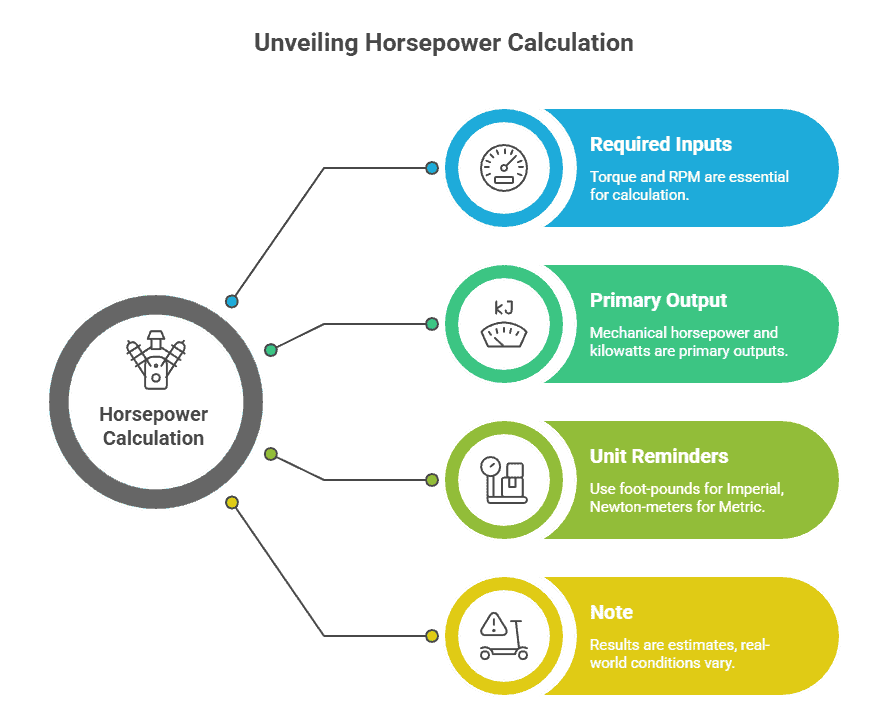
- Required Inputs: Torque (lb-ft or N·m) and Rotational Speed (RPM).
- Primary Output: Mechanical Horsepower (hp) and Kilowatts (kW).
- Unit Reminders: Ensure torque is in foot-pounds (lb-ft) for the standard Imperial formula; use Newton-meters (N·m) for the Metric path.
- Note: These results are mathematical estimates based on ideal conditions. Real-world measured horsepower (such as at the wheels) will vary due to drivetrain friction, altitude, and temperature.
Accurate Horsepower Calculator – Convert Torque & RPM to HP Instantly
Result
related automative calculators
In automotive performance and mechanical engineering, horsepower is the primary unit used to define the rate at which work is performed. Whether tuning a high-performance engine, sizing an industrial electric motor, or calculating conveyor requirements, understanding the interaction between torque and RPM is critical. This horsepower calculator resource provides the formulas and technical context needed for accurate power estimation.
What Horsepower Measures (Power vs Torque)
To use a horsepower estimator effectively, it is necessary to distinguish between rotational force and the rate of work.
Simple Definition
Horsepower is a unit of power, which is technically defined as the rate of doing work. While torque represents a force that can cause rotation, power accounts for how quickly that rotation occurs.
Why Torque Alone Isn’t Horsepower
Torque measures the capability to do work, but without movement over time, no power is generated. For example, a stalled motor may apply significant torque to a shaft, but until that shaft rotates, the horsepower output remains zero.
What RPM Changes
Rotations Per Minute (RPM) is the time-based component of the equation. Increasing the RPM while maintaining constant torque increases the total horsepower because the work is being performed more frequently.
Need to go beyond blocks? Calculate all your materials instantly with our precise Concrete Block Calculator.
Horsepower Calculator From Torque and RPM (Most Used)
The most frequent application for this tool is determining an engine’s output based on dynamometer (dyno) data.
Inputs You Need
- Torque: The rotational force, typically measured in lb-ft or N·m.
- RPM: The angular velocity of the crankshaft or output shaft.
Formula (ft-lb & RPM)
In the Imperial system, the horsepower formula is:

The constant 5252 is used to relate rotational torque to the standard definition of mechanical horsepower.
Formula (N·m & RPM → kW → HP)
For Metric units, it is standard practice to calculate Kilowatts (kW) first:

Worked Examples
Example 1: Imperial (Automotive Engine)
- Input: 350 lb-ft of torque at 4,500 RPM.
- Calculation: (350 × 4500) / 5252 = 1,575,000 / 5252.
- Result: 299.89 hp.
Example 2: Metric (Industrial Motor)
- Input: 100 N·m of torque at 3,000 RPM.
- Calculation: (100 × 3000) / 9550 = 31.41 kW.
- HP Conversion: 31.41 × 1.341 = 42.12 hp.
Try our Dunk Calculator to discover how high you need to jump to touch the rim, perform a clean
dunk or throw down a 360° windmill.
HP to Torque Calculator (Reverse Calculation)
Engineers often need to determine the required torque capacity for shafts and gears based on a known motor power rating.
When You’d Use It
- Selecting gearboxes for a specific motor horsepower.
- Determining the rotational force available at a specific operating speed for conveyors.
- Calculating input loads for milling tools.
Formulas + 1 Quick Example

Example: How much torque does a 50 HP motor produce at 1,750 RPM?
- Calculation: (50 × 5252) / 1750 = 262,600 / 1750 = 150.06 lb-ft.
Stop settling for estimates. Our Money Market Calculator is built with unique features like APY and Nominal APR conversion and an interactive growth chart. Whether you’re saving for a short-term goal or planning for the long haul, this calculator gives you the clarity you need to make the best decision for your cash.
Horsepower Formula Explained (Where the Constants Come From)
The constants used in these formulas are derived from the physical relationship between linear work and circular motion.
Why 5252 Appears
James Watt defined one horsepower as 33,000 ft-lb of work per minute. Since torque is measured along a radius, one revolution equals a distance of 2π times that radius. Dividing 33,000 by 2π results in approximately 5252.11, the constant used in Imperial calculations.
Why 9550 Appears in the kW Formula
The constant 9550 is derived similarly for SI units. It incorporates the conversion of RPM to radians per second and the definition of a Watt (one Joule per second).
Rounding and Unit Pitfalls
Using rounded constants like 5252 or 9550 is standard for most torque calculator applications, though high-precision engineering may require further decimal places. A common error is mixing Imperial torque (lb-ft) with Metric power units (kW).
Torque Basics (How to Calculate/Measure Torque)
Understanding the force behind the power is essential for accurate modeling.
What Torque Is
Torque is a rotational force produced by a lever arm. It is the product of the force applied and the distance from the center of rotation.
Measuring Torque
- Torque Wrench: Used for static measurement of fasteners.
- Dynamometer: Measures dynamic torque by applying a resistance or “brake” to an engine.
- Spec Sheets: Engineers often use peak torque values from manufacturer documentation.
Common Mistakes
The most frequent error is using an engine’s peak torque at its peak horsepower RPM. These two peaks rarely occur at the same rotational speed; calculations must use torque and RPM values captured at the same point in time.
Real-World Horsepower: Wheel vs Crank, BHP, Ratings
Calculated values often differ from real-world measurements due to mechanical losses.
Wheel Horsepower (WHP) vs Crank Horsepower
- Crankshaft Horsepower: The power measured directly at the engine’s output shaft.
- Wheel Horsepower (WHP): The power measured at the drive wheels after it has passed through the transmission and differential.
Brake Horsepower (BHP) Meaning
BHP refers to the engine’s power as measured by a brake-type dynamometer. It generally represents the engine’s output before accessories and drivetrain components are factored in.
Why Dyno Numbers Vary
Measured horsepower is affected by “drivetrain loss,” which is often estimated at 15–20% for most vehicles. Environmental factors such as altitude, temperature, and humidity also significantly impact actual performance.
Unit Conversions (hp, kW, W, PS/CV)
The term “horsepower” varies by region and convention.
Quick Conversion Table
To Convert From | To | Multiply By |
Mechanical HP (hp) | Kilowatts (kW) | 0.7457 |
Kilowatts (kW) | Mechanical HP (hp) | 1.3410 |
Metric HP (PS/CV) | Mechanical HP (hp) | 0.9863 |
Mechanical HP (hp) | Watts (W) | 745.7 |
When Each Unit is Used
- Mechanical HP: Predominant in the US and UK for automotive ratings.
- Metric HP (PS/CV): Common in Europe and South America; based on a slightly different lifting convention.
- kW/Watts: The SI standard for electrical motors and global scientific applications.
Use Cases (Automotive + Industrial)
- Cars/Motorcycles: Using a how to calculate HP guide to estimate acceleration and top speed potential.
- Electric Motors: Converting kW ratings to HP to compare electric vehicle (EV) performance with traditional engines.
- Conveyors: Calculating the horsepower requirement to move specific weight loads at required speeds.
- Milling: Determining the power needed for spindle speeds and cutting forces in manufacturing.
Frequently Asked Questions (FAQs)
Input your measured torque and the engine's current RPM into the formula: HP = (Torque × RPM) / 5252.
Yes, if you have the torque and RPM. Alternatively, multiply the motor's kW rating by 1.341 to get the mechanical horsepower.
Calculate power in kW first using (Torque × RPM) / 9550, then convert to the desired horsepower type.
You must also know the RPM at which that peak torque occurs. Using peak torque with a different RPM point will yield an incorrect result.
Use the reverse hp torque calculator formula: Torque = (HP × 5252) / RPM.
Standard formulas calculate the theoretical power at the source. It does not account for the 15–20% friction loss found in vehicle drivetrains.
PS (Metric horsepower) is based on a metric lifting convention and is approximately 1.4% less powerful than one mechanical horsepower.
Milling power depends on material removal rate and spindle torque. The same rotational power formulas apply once the required torque is determined.
Accuracy & Safety Disclaimer
This calculator provides an educational estimate based on standard formulas. Real horsepower can vary with measurement method, conditions, and equipment. For engineering or compliance decisions, confirm with manufacturer data, dyno testing, or a qualified engineer.
References
- NIST (National Institute of Standards and Technology): Special Publication 811, Guide for the Use of the International System of Units (SI).
- SAE International (Society of Automotive Engineers): J1349 and J1995 Engine Power Test Codes.
- ASME (American Society of Mechanical Engineers): Standard formulas for mechanical power and rotational torque.