
Table of Contents
ToggleUnderstanding Your Waist-to-Hip Ratio: A Complete Guide
Last Update: March, 2026
Maintaining a clear view of your body composition is essential for long-term health tracking. While weight alone doesn’t tell the full story, a Waist-To-Hip Ratio Calculator offers a more nuanced look at how your body distributes fat. This simple yet effective tool helps determine your Waist-to-Hip Ratio (WHR), a key metric used in body fat distribution analysis to identify potential health risks associated with central obesity. By using our WHR calculator, you can quickly gain insights into your physical proportions and take proactive steps toward your fitness goals.
Waist‑to‑Hip Ratio Calculator
Determine your health risk category using the WHO waist‑to‑hip ratio guidelines
Your Result
What Is Waist-to-Hip Ratio (WHR)?
The Waist-to-Hip Ratio (WHR) is a dimensionless figure derived by dividing your waist circumference by your hip circumference. This specific Hip Ratio is a critical indicator because it differentiates between fat stored around the hips and fat stored around the midsection.
Understanding the Waist vs Hip Measurement dynamic matters because “apple-shaped” fat distribution (carrying weight around the stomach) is often more closely linked to metabolic health concerns than “pear-shaped” distribution. Monitoring this ratio helps you visualize your body shape and fat distribution more accurately than a standard scale.
How to use the Waist-To-Hip Ratio Calculator
Using an online Waist To Hip Calculator is a straightforward process designed for instant feedback. The tool functions through a specific logic gate:
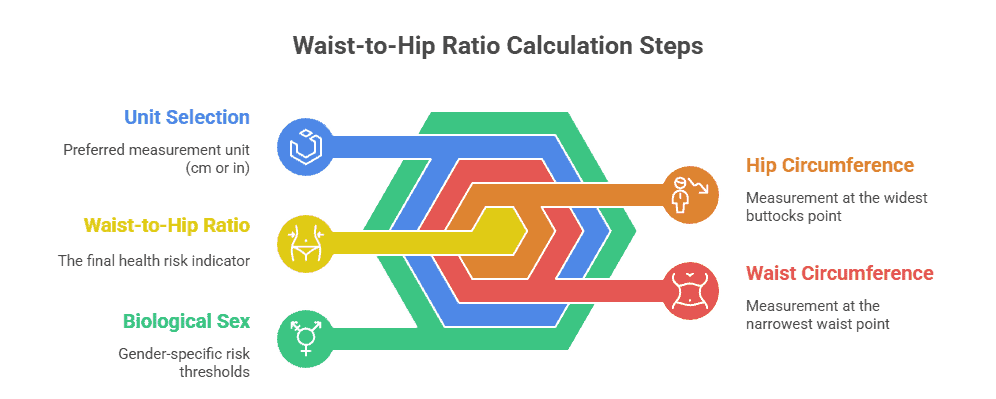
- Enter Biological Sex: Select either Male or Female from the dropdown menu, as the risk thresholds vary by gender (e.g., 0.80 for females vs. 0.95 for males for low risk).
- Select Unit: Choose your preferred unit of measurement (e.g., cm or in).
- Enter Waist Circumference: Input the measurement taken at the narrowest point above your navel.
- Enter Hip Circumference: Input the measurement taken at the widest part of your buttocks.
- Instant Results: The system processes the calculation and provides a decimal value that categorizes your health risk level and body type.
How To Measure Waist and Hips Correctly
Accuracy is vital when using a WHR Calculator. Small errors in placement can lead to misleading results. Follow this step-by-step guide for the best data:
1. How to Measure Your Waist
Exhale normally and wrap a flexible measuring tape around your natural waistline, which is typically the narrowest part of your torso, located just above the belly button. Ensure the tape is snug but not compressing the skin.
2. How To Measure Hips
To find your true hip ratio, stand with your feet together. Wrap the tape around the widest part of your buttocks. Ensure the tape is parallel to the floor all the way around.
3. Common Measuring Mistakes
- Sucking in your stomach: This provides an artificially low waist reading.
- Measuring over thick clothing: Always measure against bare skin or very thin fabric.
- Using a non-flexible ruler: Only use a soft, cloth, or flexible plastic measuring tape.
Waist-To-Hip Ratio and Body Shapes
Your WHR is the primary driver in defining your clinical body shape. Generally, these fall into three categories:
- Apple Shape Body: Characterized by a higher WHR, where the waist is wider than or nearly equal to the hips. This indicates more visceral fat storage.
- Pear Body Shape: A lower WHR where the hips are significantly wider than the waist.
- Spoon Body Shape: A variation of the pear shape where the shelf-like appearance of the hips is even more pronounced, resulting in a very distinct waist vs hip measurement.
Understanding Bust-to-Hip and Waist-to-Hip Ratios
While the Waist-To-Hip Ratio is a health-centric metric, other proportions like the Bust To Hip Ratio Maker are often used for garment fitting and aesthetic analysis.
- Waist-to-Hip Ratio: Focuses on health markers and internal fat distribution.
- Bust-to-Hip Ratio: Used primarily to determine “hourglass” proportions in the fashion industry.
- General Metrics: Both serve as body proportion metrics, but only the WHR is widely recognized by health organizations as a diagnostic tool.
Why Use a Waist-To-Hip Ratio Calculator?
Integrating this tool into your routine offers several practical advantages:
- Quick Calculation: Get a precise health metric in seconds without manual math.
- Fitness Tracking: Monitor if your exercise routine is effectively reducing midsection fat.
- Body Shape Analysis: Better understand your natural silhouette for clothing and styling.
- Health Awareness: Stay informed about your risk levels for conditions like cardiovascular disease or Type 2 diabetes.
Related calculators
Frequently Asked Questions (FAQs) About WHR
For most individuals, the World Health Organization suggests a healthy WHR is 0.90 or less for males and 0.85 or less for females.
Stand with your heels together and measure around the fullest part of your hips and buttocks, keeping the tape level with the floor.
Many experts believe WHR is a better indicator of health than BMI because it accounts for the location of fat, rather than just total weight.
Typically, the "Pear" or Spoon Body Shape yields the lowest WHR because the hip measurement is significantly larger than the waist measurement.
Our WHR calculator is highly accurate as a mathematical tool, provided your initial physical measurements are taken precisely with a flexible tape.
Reference List
- World Health Organization (WHO). Waist-to-Hip Ratio and Health Risk. 2011.
- Centers for Disease Control and Prevention (CDC).
- National Institutes of Health (NIH). The role of waist-to-hip ratio in cardiovascular disease.
- Harvard Health Publishing. Waist-to-hip ratio: What it is and why it matters. Harvard Medical School.
- Mayo Clinic Staff. Abdominal obesity. Mayo Clinic.
- Pischon, T. et al. (2008). Waist-to-hip ratio and risk of cardiovascular disease in 340 214 middle-aged men and women.
- Ashwell, M., Hsieh, S. D. (2005). Waist-to-height ratio is a simple, effective predictor of cardiometabolic risks.